https://github.com/almost6heads
 https://orcid.org/0000-0003-3294-0366

Nucleation in a Ternary Cahn-Morral Model
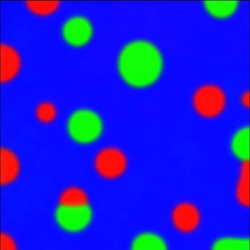
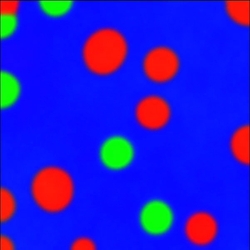
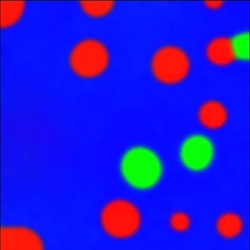
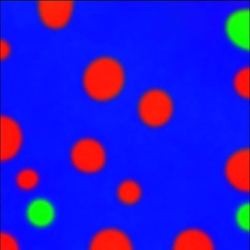
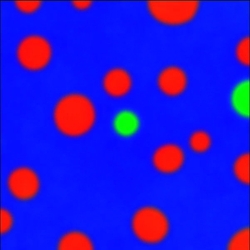
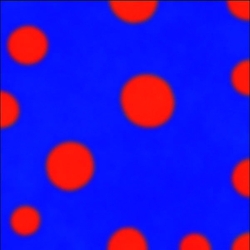
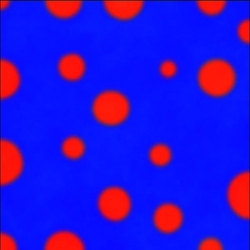
Part of my research has been focused on mathematical models for phase separation in multi-component alloys, in particular on the phenomenon of nucleation. Below you can see some movies of simulated phase separation in a ternary Cahn-Morral model in two space dimensions and with components $u$, $v$, and $w$, for a variety of values of the total mass $\mu_u$. The remaining two components have masses $\mu_v = 0.2 - \mu_u$ and $\mu_w = 0.8$. Each image links to its movie (MP4 format, about 20 seconds, no sound).
In every simulation, the mixture starts out almost homogeneous, which appears as a uniformly blue square, since the third component $w$ makes up most of the material. After some time, small droplets rich in the component $u$ (red) or in the component $v$ (green) appear at random locations and grow. Some red and green droplets form next to each other and appear half red and half green. As $\mu_u$ increases, and therefore $\mu_v$ decreases, red droplets become more common than green ones, and for $\mu_u = 0.140$ almost all droplets are red.
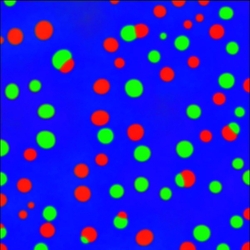
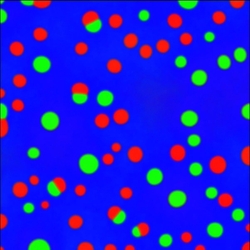
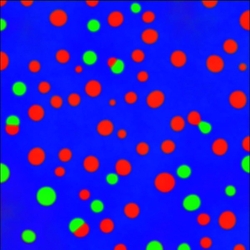
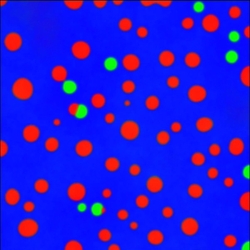

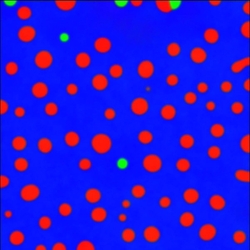


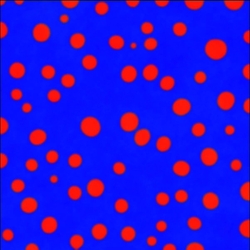
The following simulations are for the same mass values, but for larger interaction length. They show the formation of the nuclei more clearly: fewer droplets form, and each of them is larger.